Books

Uniquely Normal: Tapping the Reservoir of Normalcy to Treat Autism

Uniquely Normal: Tapping the Reservoir of Normalcy to Treat Autism

Author Robert J. Berstein has found a different approach based on cognition―thinking―in helping people of all ages with ASD. Author’s goal is for people with ASD to be able to live in the world and connect with the people in it as themselves, to express their unique humanity and engage more fully in the human interactions that give life meaning and make it worth the effort of getting out of bed every day. Author believes that whatever he does therapeutically must be on the autistic person’s terms; he or she must lead. Author’s therapy examples are categorized by age groups of: 2-5 years of age, 6-10 years of age, 11-14 years of age and 19 years of age and up.
$19.95
Unlocking the Mysteries of Sensory Dysfunction

Unlocking the Mysteries of Sensory Dysfunction

Parents are often the first to notice when a child is struggling with a sensory disorder. But even after knowing what the problem is, parents still need to know what to expect and, more importantly, what to do to help their child. This book is a parent-to-parent guide for raising a child with Sensory Integration Disorder. Using nonmedical language, the authors walk you through the challenges that children may face, such as being uncomfortable with hugs and kisses, experiencing a "fight or flight" sensation when brushing teeth or combing hair, etc. The two moms give tips and advice for school, home, and the future. Helpful sections include:
  • Sensory Integration
  • Sensory Systems
  • The Undiagnosed Child
  • The Symptoms
  • Early Diagnosis
  • The System
  • Issues At Home
  • Issues At School
  • The Family
  • Treatment Options
$12.99
Unwritten Rules of Social Relationships: Decoding Social Mysteries through the Unique Perspectives – Revised 2017

Unwritten Rules of Social Relationships: Decoding Social Mysteries through the Unique Perspectives – Revised 2017

Born with autism, both Temple Grandin and Sean Barron now live famously successful social lives. However, their paths were quite different. Temple's logical mind controlled her social behavior. She interacted with many adults and other children, experiencing varied social situations. Logic informed her decision to obey social rules and avoid unpleasant consequences. Sean's emotions controlled his social behavior. Baffled by social rules, isolated and friendless, he made up his own, and applied them to others. When they inevitably broke his rules, he felt worthless and unloved. Both Temple and Sean ultimately came to terms with the social world and found their places in it. Whether you are a person with autism, a caregiver in the autism community, or just someone interested in an outsider view of society, their powerful stories will enthrall and enlighten you.
$21.95
Visual Support for Children with Autism Spectrum Disorders

Visual Support for Children with Autism Spectrum Disorders

Combining their years of experience working with individuals on the autism spectrum, both here and around the world, authors Vera Bernard-Opitz and Anne Häußler bring teachers and other professionals practical ideas and teaching methods for offering visual supports to students with autism spectrum disorders and other visual learners. With hundreds of colorful illustrations and step-by-step directions, this book lays the foundation for how to structure teaching environments, as well as offers countless examples of activities for students, ranging from basic skills, to reading and math, to social behavior.
$34.95
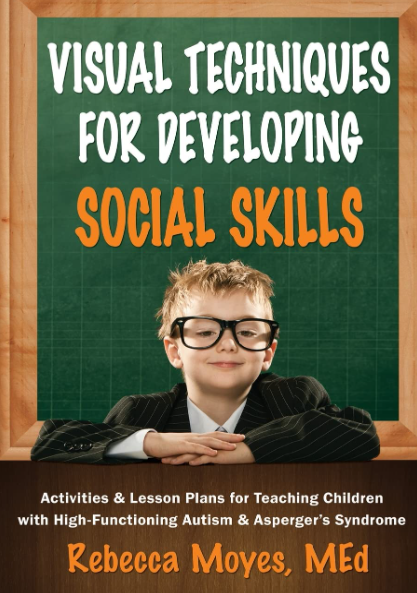
Visual Techniques for Developing Social Skills

Visual Techniques for Developing Social Skills

This book provides practical, hands-on strategies for teaching social skills to children with high-functioning autism and Asperger’s Syndrome. For use in both general education and special education classrooms, each chapter includes a detailed description of the social deficits of these children and ways to address them. Such issues include difficulties with understanding idioms, taking turns in conversation, understanding tone of voice, and body language.
$14.95
Visual Thinking: The Hidden Gifts of People Who Think in Pictures, Patterns, and Abstractions

Visual Thinking: The Hidden Gifts of People Who Think in Pictures, Patterns, and Abstractions

INSTANT NEW YORK TIMES BESTSELLER WINNER OF THE NAUTILUS GOLD AWARD “A powerful and provocative testament to the diverse coalition of minds we’ll need to face the mounting challenges of the twenty-first century.” —Steve Silberman “An absolute eye-opener.” —Frans de Waal A landmark book that reveals, celebrates, and advocates for the special minds and contributions of visual thinkers A quarter of a century after her memoir, Thinking in Pictures, forever changed how the world understood autism, Temple Grandin— “an anthropologist on Mars,” as Oliver Sacks dubbed her—transforms our awareness of the different ways our brains are wired. Do you have a keen sense of direction, a love of puzzles, the ability to assemble furniture without crying? You are likely a visual thinker. With her genius for demystifying science, Grandin draws on cutting-edge research to take us inside visual thinking. Visual thinkers constitute a far greater proportion of the population than previously believed, she reveals, and a more varied one, from the photo-realistic “object visualizers” like Grandin herself, with their intuitive knack for design and problem solving, to the abstract, mathematically inclined “visual spatial” thinkers who excel in pattern recognition and systemic thinking. She also makes us understand how a world increasingly geared to the verbal tends to sideline visual thinkers, screening them out at school and passing over them in the workplace. Rather than continuing to waste their singular gifts, driving a collective loss in productivity and innovation, Grandin proposes new approaches to educating, parenting, employing, and collaborating with visual thinkers. In a highly competitive world, this important book helps us see, we need every mind on board.
$18.00
What I Wish I’d Known About Raising a Child with Autism: The First 5 Years

What I Wish I’d Known About Raising a Child with Autism: The First 5 Years

Bobbi Sheahan, mother of a child with autism, and psychologist Kathy DeOrnellas, Ph.D., did not write this book to lecture you on how to parent your child. Instead, they offer themselves as your scouts in the field, who have valuable information to share from the moment you realize your kid is different (My, what a quiet baby I have!), to the self-righteous moms on the playground, to holding your marriage together and the realm of routines. They candidly tackle ASD issues such as: Picky Eating Bedtime Battles Potty Training Speech Delays Discipline Early Intervention Sibling Rivalry And much more!
$17.95
What Really Works for Children with Autism

What Really Works for Children with Autism

What Really Works for Children with Autism aims to be a guide for anyone who has a child with autism, as well as for educators and caregivers. Many difficulties for these children arise due to a lack of knowledge about exactly what autism is and what its consequences are. This book provides detailed information about these issues, including:  
  • What the 10 most important needs of autistic children are.
  • Understanding their sometimes unexpected or difficult behavior.
  • How to support them as a parent, teacher, caregiver, or therapist.
    When you get to know the specific characteristics, abilities, challenges and needs of a child with autism better, you will see their behavior in a different light. Knowing how their brain works and what their real needs are will give you a deeper understanding of why things can be difficult for them and you. What Really Works for Children with Autism also helps you to develop strategies that will create positive moments at home or in the classroom, so that autistic children can develop meaningful relationships with the important people in their lives. As mentioned, the authors note that autistic children have ten major needs:  
  1. Being understood
  2. Clarity
  3. Predictability
  4. Autonomy
  5. Connection
  6. Good agreements and rules
  7. Positive self-esteem
  8. Contentment
  9. Meaning
  10. Encouragement
$29.95
Who Took My Shoe?

Who Took My Shoe?

Brett and his dog Herman embark on a search for Brett’s mysteriously missing shoe. They playfully and methodically ask questions such as, “Who took it? What happened to it? How can I find my shoe?” The answers are pretty hilarious, until Brett finally asks the right one, and discovers his shoe in a most unlikely place! Although written to teach the concepts of who, what, where, why, when and how questions for children on the autism spectrum, Who Took My Shoe? will teach, entertain, and delight all youngsters.
$11.95
You Can’t Make Me: Proactive Strategies for Positive Behavior Change

You Can’t Make Me: Proactive Strategies for Positive Behavior Change

A unique look at behavior through the child's perspective! Every parent has experienced behavior challenges with their children. This book applies a whole- person perspective toward behavior management that connects across home, school, and community. It describes the functions of behavior from both the adult and child's perspective and offers simple, effective evidence-based strategies for creating behavior plans that work. Features: Behavior Plan template; Behavior, communication, & social skills strategies for each function of behavior.
$21.95
Your Life is Not a Label: A Guide to Living Fully with Autism and Asperger’s Syndrome for Parents, Professionals and You!

Your Life is Not a Label: A Guide to Living Fully with Autism and Asperger’s Syndrome for Parents, Professionals and You!

Jerry Newport, diagnosed with Asperger's Syndrome / High Functioning Autism at age 47, wrote this book for those with developmental disorders, but it resonates with people with any disability. His message: everyone has the power, and the right, to improve the quality of their lives despite their disability. Don't believe you must be "normal" to be happy; learn to co-exist with neuro-typicals, and become the best human being you can be. Jerry candidly reveals his own failures and successes. His heartfelt advice stems from a deep sense of caring for "his people" on the spectrum. If you read only one personal account about autism, this should be it!
$19.95